IT professionals find the visibility offered by traditional monitoring solutions insufficient
73%
According to a study by the independent research firm Vanson Bourne, 73% of IT professionals surveyed consider the level of visibility offered by their IT monitoring solution to be insufficient.
Challenge #1
The new business orientation of IT departments
IT infrastructure must be always on
The information system is the backbone of your company. A service outage means that all or some of your employees cannot carry out their daily tasks. In industrial companies, manufacturing and/or shipping of goods comes to a halt. Such production stoppages inevitably cause financial losses for your company, greater or smaller depending on how long they last.
When it comes to IT monitoring, a proactive strategy is now essential. Firefighting is no longer enough. The monitoring team, and the IT team at large, must be able to anticipate incidents and take the necessary measures before the company’s departments are affected.
Your IT monitoring solution must therefore give you a global view of your IT infrastructure, updated in real time. The well-known “service weather” model offered by many IT monitoring solutions is no longer enough. From a centralized view, you must be able to detect any weak point in your information system within seconds, automatically, without manual searching or analysis.
IT teams must focus on value-added tasks
In today’s economy, time spent deploying, configuring or maintaining IT infrastructure or IT solutions has little value. All these low-value tasks must be automated. The real value of IT professionals lies in thinking, optimizing and leading projects related to the company’s digital transformation.
Just like sales, marketing or operations, the IT department is now a real driver of the company’s competitiveness. Securing the IS against threats, shadow IT, improving the user experience and IoT are the real issues of the coming years.
Your IT monitoring solution must therefore adapt to IT teams’ new challenges. It must be automated and intelligent:
- Deployment should take only a few minutes.
- Evolution should be automatic and seamless.
- IS weaknesses should be visible at a glance.
- An alerting system with automatic default thresholds should be available.
Challenge #2
The growing complexity of information systems
A fragmented IT infrastructure
Internationalization, disaster recovery plans, cloud usage, connected devices and more: IT infrastructures now span several sites, cities or even countries. It is therefore increasingly complex to get an exhaustive view of the elements that make up the information system, their links and dependencies. Yet a proactive approach to incident management requires access to a complete, clear map of the information system.
Your IT monitoring solution must therefore automatically detect any new physical or virtual element of your IT system to maintain a complete inventory. You must also be able to see all the links between elements, their dependencies and the uplinks between switches and routers.
So, when an incident affects a physical element (switch, router, hypervisor, etc.) of your IT infrastructure, your monitoring system displays the full list of dependent elements affected in a cascade.
Challenge #3
The talent shortage
Difficulty recruiting IT profiles
One of the main challenges facing IT departments is the difficulty of recruiting IT profiles that match their needs in terms of education, experience or specialization. It can take months before a position is actually filled, and significant training is often needed before new hires become autonomous. This trend is also set to grow in the coming years: IT is the sector expected to see the strongest growth in France (+26% job openings by 2030, according to a projection based on INSEE studies).
Increasingly generalist profiles
This shortage of specialized profiles is leading to more recruitment of junior or generalist profiles. The solutions used must therefore adapt to these new profiles by becoming simpler and more automated, so they are accessible to people without deep expertise. This trend has been visible for several years with the rise of no-code, hyperconvergence and, more recently, SASE (Secure Access Service Edge) for networking. One-click is becoming the new paradigm for managing the information system.
Yet few IT monitoring solutions have adopted this new model. Legacy IT monitoring solutions still require a significant investment in person-time, notably because of overly complex deployments, configurations and analyses. The new generation of IT monitoring must break free from this complexity by offering IT teams a new, more immersive and intuitive experience.
Discover Shwett, the new 3D IT monitoring solution
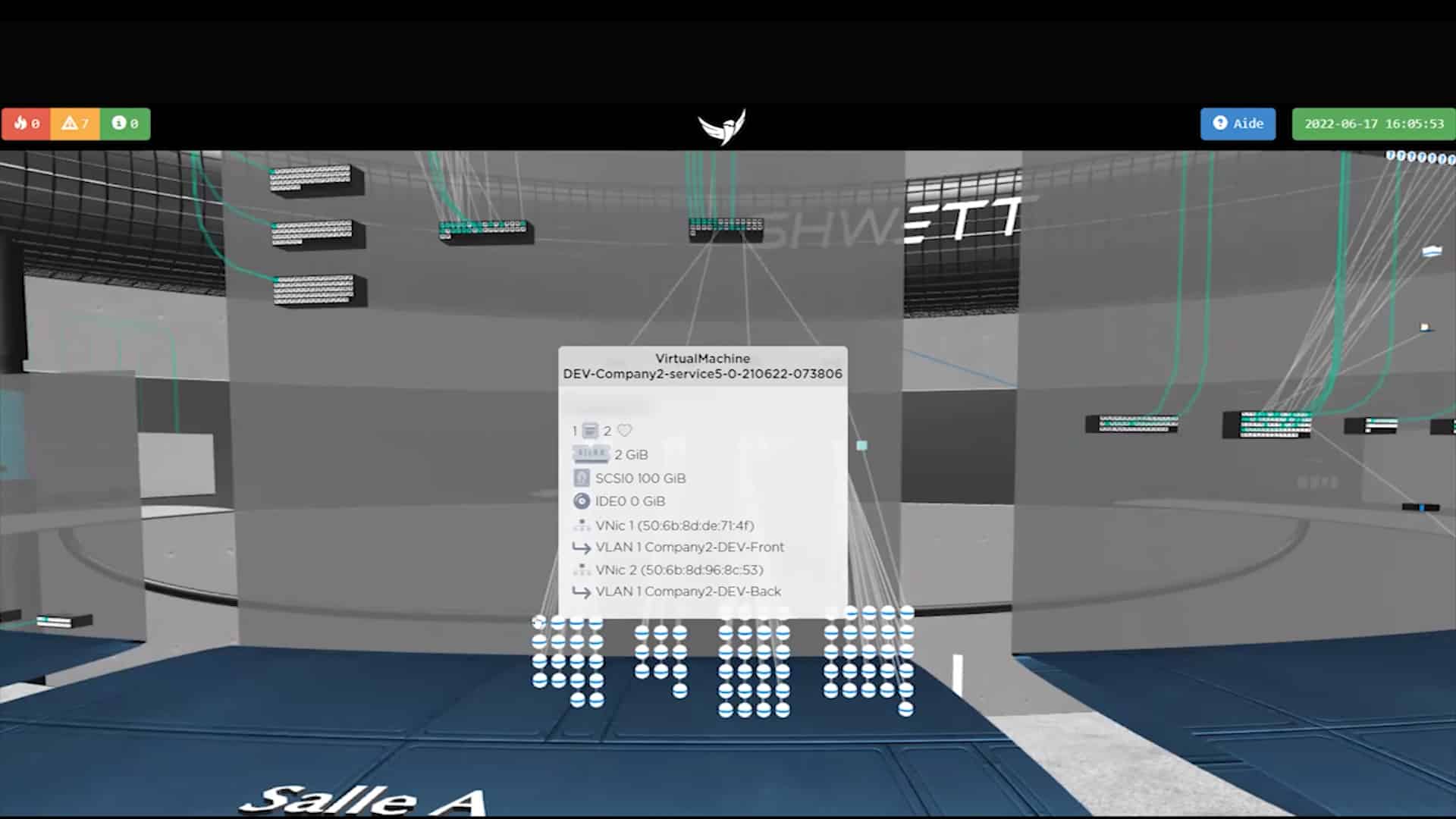
Shwett shakes up existing IT monitoring models. The new IT monitoring solution gives you a unique view of your IT infrastructure modeled in 3D. Navigate your information system and detect SPOFs at a glance.
Deploying Shwett takes just a few minutes. Are you ready for an immersive, intuitive monitoring experience?
Leave a Reply