Unified IT documentation and mapping
IT documentation: better knowledge for better control
IT documentation plays an essential role in keeping information systems (IS) running smoothly over time. Yet it is often not a priority for IT departments.
Complexity, lack of time or of a framework: the obstacles of a traditional approach to IT documentation are many. It is time for IT teams to adopt an automated, unified approach to documentation.
What is IT documentation, or information system documentation?
IT documentation, a core practice of frameworks such as ITIL (Information Technology Infrastructure Library), consists of creating and maintaining documents and information about all the components, configurations, procedures and interactions within an IT environment. It aims to make the IS transparent, accessible and understandable for all stakeholders.
Why document your information system?
Many companies still neglect IS documentation, preferring an informal approach where each department or employee manages its own information. This approach can lead to blind spots and partial knowledge of the infrastructure, creating major risks:
- Longer intervention times when an incident occurs, because you first have to find where the problem is.
- A risk of cascading impact due to poor knowledge, which can lead to ineffective or incorrect interventions.
Knowing your IS for greater efficiency and productivity
Structured IS documentation has many benefits:
- It provides unified knowledge of the IS for all internal and external stakeholders, improving communication and speeding up problem resolution.
- It gives new team members or external providers access to a knowledge base and history, making onboarding and knowledge transfer easier.
- Granular knowledge of the IT architecture is essential for evolution, migration or redesign projects, ensuring precise planning and smooth implementation.
- Proper documentation helps avoid the build-up of technical debt by identifying areas that need updating or improvement.
IT documentation: a requirement for ISO 27001 certification
In many industries, ISO 27001 certification is essential to demonstrate compliance with information security requirements. Structured IS documentation is a prerequisite for this certification, as it demonstrates rigorous management of sensitive information and data.
How do you set up or optimize your IT documentation strategy?
Effective documentation requires a methodical approach. Here are some best practices to get started:
Involve stakeholders: it is essential to involve all stakeholders, from the CIO to technicians, administrators and architects. Everyone must understand why documentation matters for the IS to run smoothly.
Create a unified framework: set up granular processes and templates for different types of documentation. These templates should specify the information to fill in, creating consistency across the documentation.
Centralize documentation: make sure documentation is centralized and accessible to all relevant stakeholders, so information stays up to date and easy to find when needed.
Which elements of the information system should you document?
To ensure an in-depth understanding of the IS, certain key elements must be documented:
Hardware components: servers, switches, routers, PCs, printers, UPS units, etc.
Network settings: document network configurations, including VLANs, as well as the links and dependencies between IS components.
Procedures and contacts: include the steps to follow and the decision chain for different actions, so everyone follows the same procedures.
What types of IT documentation should you store?
A variety of documents is needed to cover every aspect of the IS. Here are a few examples:
Manufacturer documentation: manuals and documents supplied by manufacturers are essential to understand each component in detail.
Operating manuals: these describe configurations, backup procedures, licenses, technical support levels, etc.
Installation and shutdown procedures: document installation and shutdown steps so others can perform these tasks when needed.
Intervention reports: record past interventions for future reference.
Provider and hotline contacts: keep a list of contacts for maintenance providers or hotlines.
Acceptance and test books: document test and acceptance results to validate correct operation.
DRP/BCP (Disaster Recovery Plan/Business Continuity Plan): these critical plans must be documented to ensure an effective response in the event of a disaster.
Documenting your IS with SHWETT
When it comes to documenting a complex information system, an innovative, automated approach can greatly simplify and improve the process. SHWETT, an advanced IS documentation solution, offers a groundbreaking methodology to document your IS comprehensively and efficiently. Let’s take a closer look at how SHWETT can transform the way you document your IS.
Automatic mapping
One of the main challenges of IS documentation is collecting accurate, up-to-date information about hardware and software components and how they interact. SHWETT offers automatic mapping that simplifies this tedious process:
Automatic detection of IS elements: SHWETT uses automated detection to identify every IS component, from servers to peripherals and network equipment, removing the need to identify each component manually.
Automatic typing of detected elements: SHWETT goes beyond detection by automatically assigning key information to each element. Information such as manufacturer, model, IP address, MAC address and even configuration details such as number of cores, RAM and memory is collected and recorded.
Automatic detection of links and dependencies: SHWETT identifies the links and dependencies between IS elements, so you can see how components interact and understand the implications of a change or incident.
Automatic updates: one of SHWETT’s key advantages is that documentation updates automatically. Information is refreshed in real time, avoiding time-consuming manual work and the risk of errors or omissions, so your documentation is always accurate and up to date.
Unified access to documentation
Once IS elements are mapped and information collected, SHWETT provides a unified interface to access this information and your custom documentation:
Access through the 3D view of the IS: SHWETT offers a 3D visual representation of your IS. When an incident occurs or information is needed, simply navigate the view to quickly find the element in question.
1-click access to history and procedures: when an incident affects an element, SHWETT gives instant access to the history of past interventions and incidents related to it. Troubleshooting and restart procedures are also one click away, for faster resolution.
Direct access to management consoles: SHWETT provides direct access to the management consoles of each element, whether over HTTP, HTTPS, SSH or RDS, for fast, targeted intervention when needed.
Predefined or custom queries with ChatGPT: SHWETT integrates ChatGPT for advanced interactions. You can run predefined queries or ask custom questions about common procedures and get detailed answers.
IS documentation with SHWETT transforms the way companies manage and maintain their IT infrastructure. With automatic mapping, unified access to documentation and ChatGPT integration, SHWETT makes documentation more efficient, accurate and accessible. By adopting this innovative approach, companies can not only improve operational efficiency but also reduce risks and intervention times when incidents occur, contributing to better overall management of their information system.
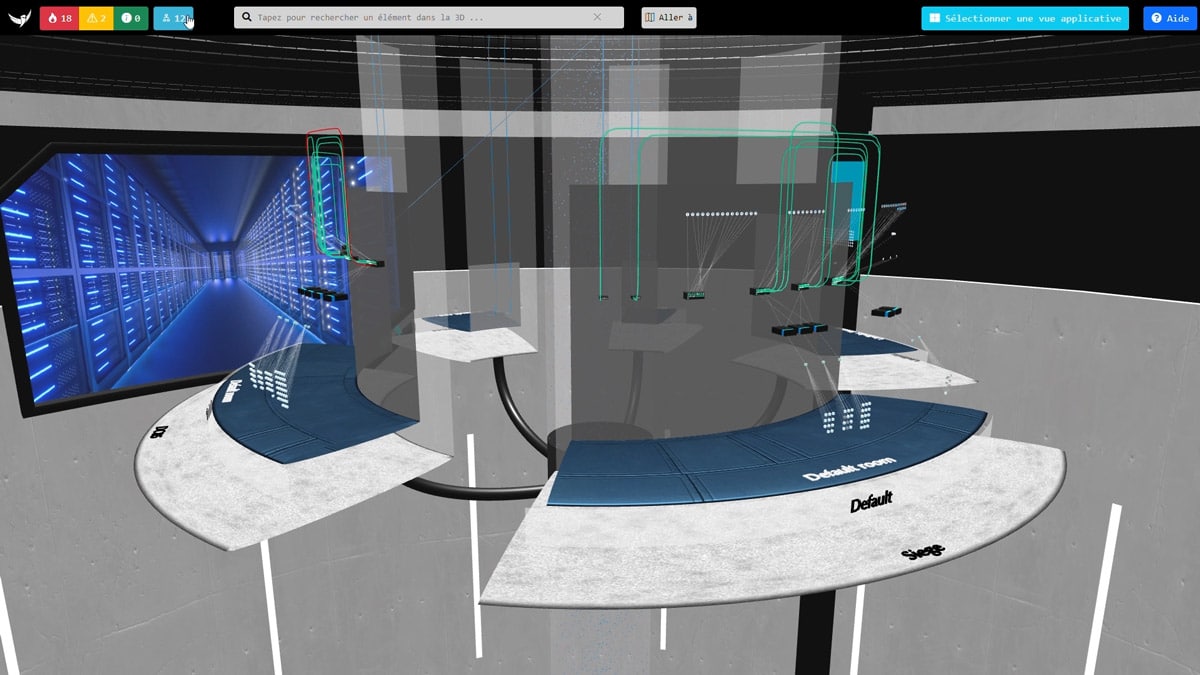
Create your 3D map in 1 click
Deploy the SHWETT probe and start monitoring and managing your infrastructure from a unified 3D view.
Free 14-day trial.